A muscle pull, or muscle strain, happens when muscle fibres are overstretched or torn. The main causes of muscle pull are sudden overstretching, overuse, an inadequate warm-up, fatigue and poor technique. In football, almost every case starts with a sprint, a stretch for the ball or a tired leg late in a game.

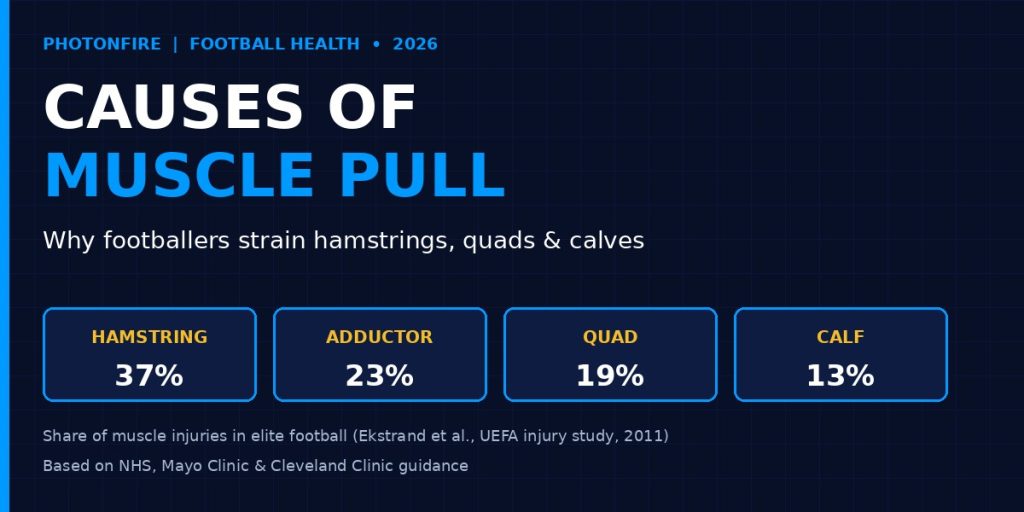
UEFA’s Elite Club Injury Study found that muscle injuries make up 31% of all injuries in elite football. This guide explains why, using real cases from the latest football injury updates.
TL;DR
- What it is: overstretched or torn muscle fibres (a strain). A sprain is a ligament injury.
- Top causes: sudden overstretching, overuse, cold muscles, fatigue, poor technique, muscle imbalance, dehydration and an old injury.
- Most affected in football: hamstrings (37%), adductors (23%), quadriceps (19%) and calves (13%).
- Overnight healing is not possible. Most mild strains feel better after about 2 weeks.
- First aid: PRICE for 2 to 3 days, then gradual loading (PEACE & LOVE).
What Is a Muscle Pull?
A muscle pull is the everyday name for a muscle strain. The NHS defines a strain as an “overstretched or torn muscle (also known as a pulled muscle)”. The damage can also reach the tendon that joins muscle to bone.
A pulled muscle shows up as sudden pain, tenderness, swelling or bruising, and weakness when you try to use it.
Causes of Muscle Pull (Muscle Strain)
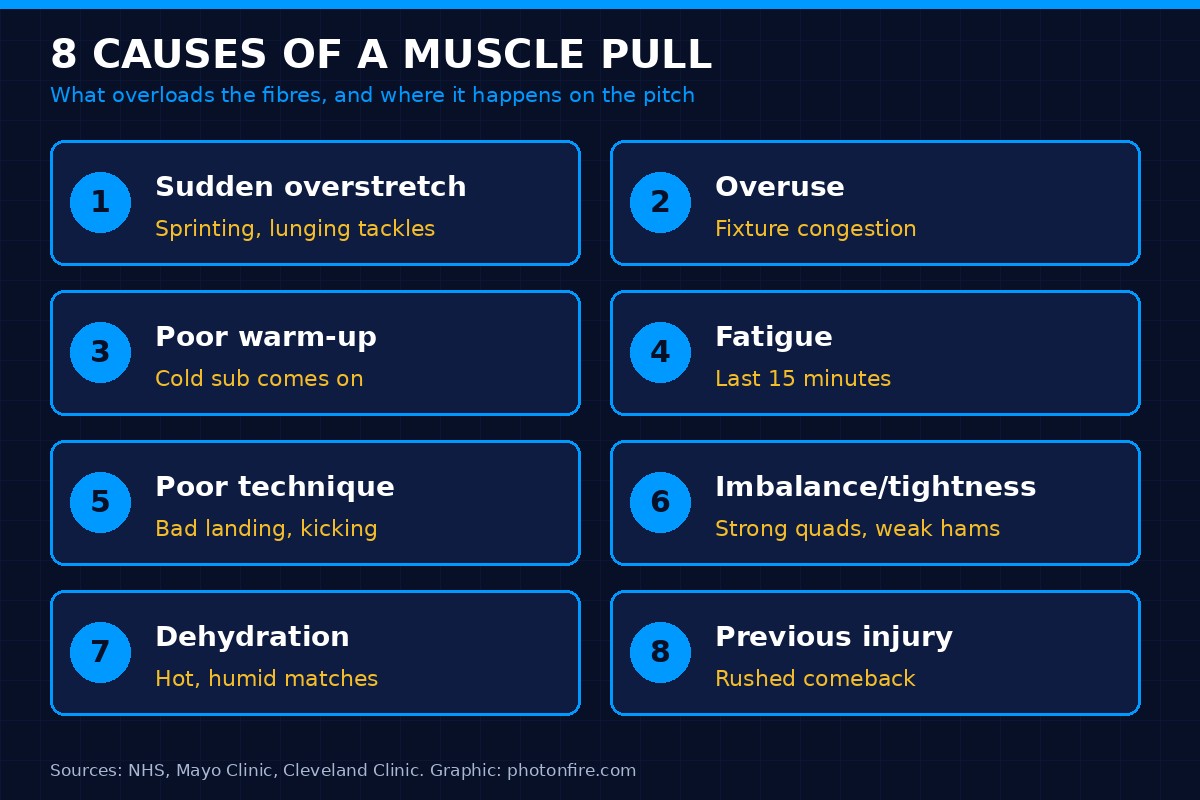
A muscle pull happens when muscle fibres are overstretched or torn. The most common causes are sudden overstretching, overuse, an inadequate warm-up, muscle fatigue and poor technique.
| Cause | How it happens | Common football situation |
|---|---|---|
| Sudden overstretching | The muscle is forced beyond its normal range while contracting | Sprinting in behind, a lunging tackle, a long stretch for the ball |
| Overuse / repetitive stress | Small tears build up from repeated loading without enough rest | Fixture congestion, two games a week |
| Inadequate warm-up | Cold muscles are tighter and less elastic | A substitute sprinting straight after coming on |
| Muscle fatigue | Tired muscles lose strength, coordination and shock absorption | The last 15 minutes of a match or extra time |
| Poor technique | Incorrect form puts extra stress on one muscle | Awkward landings, over-striding, poor shooting mechanics |
| Muscle imbalance or tightness | One muscle group overpowers its opposite | Strong quadriceps with weak hamstrings |
| Dehydration and electrolyte loss | Muscles cramp and tire sooner | Hot, humid matches and pre-season in summer |
| Previous injury | Scar tissue and incomplete rehab raise the risk of re-injury | A rushed comeback after a hamstring strain |
Acute vs chronic causes
Acute causes are sudden: an explosive sprint, a kick, a quick change of direction, eccentric loading (the muscle lengthening while it contracts hard), a direct blow, or a slip. Chronic causes build up over time through repetitive movement, high training loads and poor posture.
Key risk factors
- Explosive movements such as sprinting, jumping and sudden turns
- Training or playing while fatigued
- A rapid increase in training volume or intensity
- Cold weather or cold muscles
- Muscle imbalances and poor flexibility
- A previous strain in the same muscle (16% of muscle injuries in the UEFA study were re-injuries)
Commonly affected muscles
Hamstrings, quadriceps, calves, groin (adductors), lower back and shoulder muscles. In elite football, 92% of muscle injuries hit the four big lower-limb groups.
Based on standard sports medicine guidance from Mayo Clinic, Cleveland Clinic and NHS, plus the UEFA Elite Club Injury Study (Ekstrand et al., 2011).
What Causes Muscle Pull in the Legs?
Leg muscles do the sprinting, kicking and braking, so they take the most load. The hamstring is most at risk at the end of the swing phase of a sprint, when it lengthens to slow the shin down. That is why so many strains happen when a winger accelerates.
Bukayo Saka is a current example. BBC Sport reports that Arsenal fear he will be out for at least six weeks with a quadriceps injury. Chelsea’s João Pedro has a thigh injury that will keep him out for “a few weeks”, according to Xabi Alonso. Both are tracked on our football injury updates page, alongside the latest Arsenal news and Chelsea injury news.
Causes of Muscle Pull in the Leg While Sleeping or at Night
Sudden pain in the leg at night is usually a cramp, not a strain. The NHS says leg cramps are common, usually harmless, last a short time, and happen most often at night or when resting. Overworking the muscles during exercise (worse in hot or humid weather), ageing, pregnancy and some medicines can all play a part.
A cramp passes within minutes and leaves, at most, soreness. A real strain follows a specific movement and causes lasting pain, swelling or bruising.
Causes of Muscle Pull in the Foot
The small muscles of the foot and the long calf tendons strain through overuse, sudden push-offs, poor footwear and hard pitches. Pain under the arch or heel often comes from the plantar fascia rather than muscle. Our foot pain causes guide covers those conditions and the players who lived with them.
Causes of Muscle Pull in Pregnancy and at Night During Pregnancy
During pregnancy, hormones soften the ligaments, and the growing bump shifts your posture. The NHS says this can strain the lower back and pelvis. Night-time leg cramps are also common, usually in the later stages of pregnancy. Severe, one-sided or worsening pain, or calf swelling, needs a midwife or GP straight away rather than home treatment.
Torn Muscle vs Pulled Muscle
Every pulled muscle involves some torn fibres, so the difference is how many. A mild (grade I) pull damages a small number of fibres. A grade II strain is a partial tear with clear weakness. A grade III injury is a complete tear or a tendon rupture, sometimes with a visible gap or a “pop”, and it may need surgery.
Sprain Meaning: Sprain vs Strain
A sprain is a torn or twisted ligament, the tissue that connects bones at a joint. A strain affects a muscle or tendon. The NHS notes that sprains are most common in the wrists, ankles, thumbs and knees, while strains are most common in the legs and back. A rolled ankle in a tackle is a sprain. A hamstring that “goes” mid-sprint is a strain.
The Worst Muscle Injuries in Football History
These cases show how long the road back can be.
| Player | Injury | What happened | Time out |
|---|---|---|---|
| Ronaldo (Inter, April 2000) | Ruptured right patellar tendon | Collapsed about seven minutes into his comeback against Lazio, weeks after surgery on the same tendon | Seven to eight months of rehab (BBC) |
| Ousmane Dembélé (Barcelona, Sept 2017) | Ruptured biceps femoris (hamstring) tendon | Pulled up 29 minutes into his first La Liga start, against Getafe; surgery in Finland | About three and a half months |
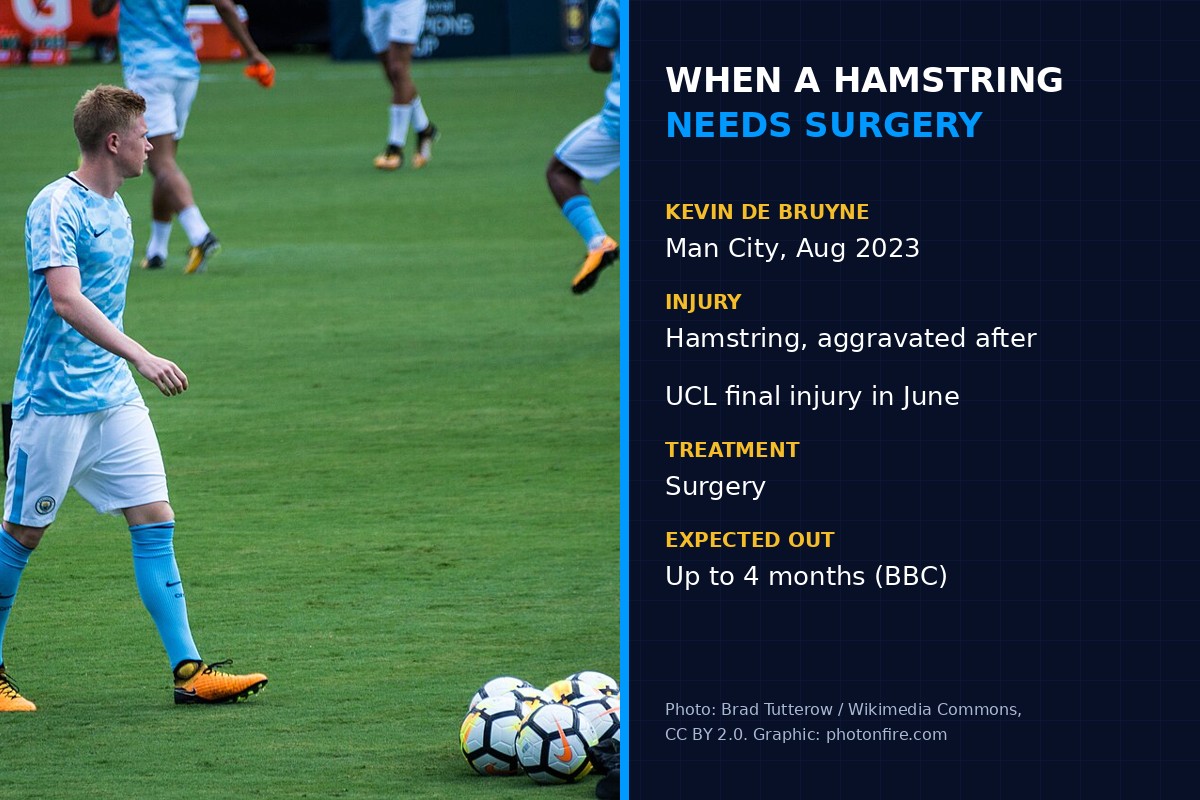
| Kevin De Bruyne (Man City, Aug 2023) | Hamstring, needing surgery | Limped off after 23 minutes at Burnley, having gone off in the Champions League final in June | Up to four months |
| Bukayo Saka (Arsenal, Oct 2026) | Quadriceps | Fluid around the muscle delayed a clear diagnosis | At least six weeks expected |
Ronaldo’s case is a tendon injury rather than a pure muscle strain, but it is the clearest warning about returning too soon. De Bruyne had played through hamstring pain for two months before it went. For more player stories, see our Moisés Caicedo injury profile and Real Madrid injury news.
Muscle Strain Treatment at Home
For the first 2 to 3 days, the NHS recommends PRICE:
- Protect the injury from further damage.
- Rest it and stop the activity.
- Ice it for up to 20 minutes every 2 to 3 hours, wrapped in a towel.
- Compress it with a bandage.
- Elevate it on a pillow.
The NHS also advises avoiding heat, alcohol and massage for the first couple of days. Many sports physios now use the newer PEACE & LOVE framework, published in the British Journal of Sports Medicine. PEACE covers the early days: Protect, Elevate, Avoid (anything that blunts early healing), Compress and Educate. LOVE covers what follows: Load, Optimism, Vascularisation (pain-free cardio) and Exercise.
How to Speed Up Muscle Strain Recovery
- Start gentle movement as soon as pain allows. Muscles heal stronger when they are loaded gradually.
- Follow a graded strengthening plan, such as eccentric hamstring work like Nordic curls.
- Keep fit with pain-free cycling or swimming.
- Do not return to sprinting until you have full strength and range in the muscle.
Can You Heal a Pulled Muscle Overnight?
No. Muscle fibres need weeks to repair, and no treatment changes that. A pull that feels fine the next morning was probably a cramp or minor tightness. The NHS says most strains feel better after about 2 weeks, and you should avoid strenuous exercise such as running for up to 8 weeks. Cleveland Clinic says severe tears can take four to six months after surgery. Even elite clubs lose players for weeks, as our injury tracker shows.
Causes and Remedy of Muscle Pull: Prevention for Players
| Cause | Remedy or prevention |
|---|---|
| Cold muscles | A dynamic warm-up such as FIFA 11+ |
| Fatigue | Load management and rotation |
| Imbalance | Eccentric strength work |
| Dehydration | Hydrate before, during and after play |
| Previous injury | Complete the rehab before you return |
Injuries shape team news in our correct football prediction picks and Manchester City injury news.
Medical disclaimer: This article is for general information only and is not medical advice. See a doctor, physiotherapist or pharmacist about any injury, especially severe pain, a “pop”, inability to bear weight, or symptoms during pregnancy.
Related Reading on Photonfire
- Football Injury Updates (2026)
- Foot Pain Causes: Types, Symptoms and Footballers
- Man Utd News Now: Injuries
- Arsenal Breaking News Now
- Chelsea News Now: Injuries
- Real Madrid News Now
- Hansi Flick Barcelona
- Lamine Yamal Salary and Career
- Man City Manager
- Nigeria National Football Team Players
- England vs Spain Prediction
- Mexico National Football Team
- Ballon d’Or 2026 Winner
- Champsquads injury updates
Sources (2026)
- NHS: Sprains and strains
- NHS: Leg cramps
- NHS: Back pain in pregnancy
- NHS: NSAIDs
- Mayo Clinic: Sprains and strains
- Cleveland Clinic: Muscle strains
- Ekstrand et al. (2011), Epidemiology of muscle injuries in professional football, UEFA study (PubMed)
- Dubois & Esculier (2020), PEACE & LOVE, BJSM
- BBC News: Ronaldo to play again in 2001
- BBC Sport: Dembélé out for three and a half months
- BBC Sport: De Bruyne has hamstring surgery
- BBC Sport and The Guardian, October 2026 (Saka and João Pedro), via our injury updates page
FAQ
What is the best medicine for a pulled muscle?
For short-term pain, the NHS says paracetamol or an over-the-counter NSAID such as ibuprofen tablets or ibuprofen gel can help. NSAIDs are not suitable for everyone, including people with stomach ulcers, some heart or kidney conditions, or who are pregnant. Ask a pharmacist or doctor which is right for you before taking anything.
What foods help muscle recovery?
Protein-rich foods such as eggs, fish, chicken, beans and dairy give the body the building blocks to repair muscle. Fruit, vegetables and whole grains add vitamins, minerals and energy. A balanced diet matters more than any single “superfood”.
What to drink for muscle recovery?
Water is the main drink. After long or hot sessions, milk or a drink with electrolytes can help replace fluid and salts lost in sweat. Avoid alcohol, which slows healing and adds to swelling in the first few days.
What can be mistaken for a muscle strain?
A ligament sprain, a stress fracture, tendinopathy, a nerve problem such as sciatica, and a deep vein thrombosis (DVT) can all feel like a pulled muscle. A swollen, warm, painful calf with no clear injury needs urgent medical attention to rule out a blood clot.