
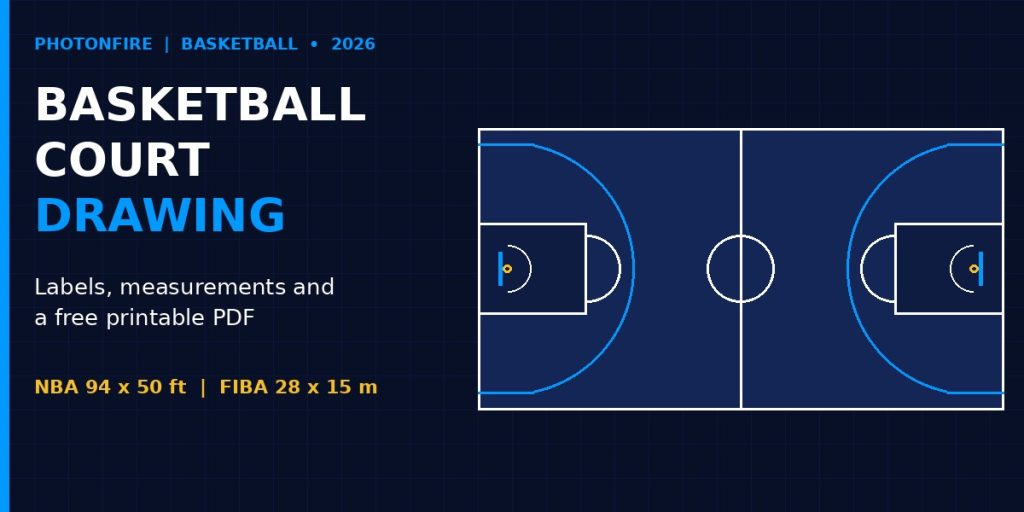
A basketball court drawing is a top-down rectangle, 94 by 50 feet in the NBA or 28 by 15 metres under FIBA rules, marked with a centre line and circle, two free-throw lanes, two three-point arcs, restricted-area arcs and a backboard and rim at each end. This guide gives you the official measurements, a labelled diagram, five drawing steps, a scale method for pencil and paper, driveway sizes and a free printable PDF.

TL;DR: Basketball Court Drawing in 30 Seconds
- Shape: a rectangle, long sides are sidelines, short sides are baselines.
- NBA size: 94 ft x 50 ft, rim 10 ft high.
- FIBA size: 28 m x 15 m, rim 3.05 m high.
- Draw in order: boundaries, centre line and circle, backboards and hoops, the paint, then the three-point lines.
- Easy scale: 1 cm = 1 m (FIBA) or 1 inch = 10 ft (NBA).
- Free download: our basketball court drawing PDF has every label and measurement.
Standard Basketball Court Drawing (NBA Dimensions)
A standard basketball court is a rectangle with fixed markings for official play. The NBA Rulebook (Rule No. 1) sets the court at 94 feet long and 50 feet wide, with every line 2 inches wide. Use these numbers to draw a standard basketball court in feet, or to check any drawing of a standard basketball court you find online.
| NBA element | Measurement |
|---|---|
| Length | 94 ft (28.65 m) |
| Width | 50 ft (15.24 m) |
| Free-throw line | 15 ft from the face of the backboard |
| Free-throw lane width | 16 ft |
| 3-point line (top of arc) | 23 ft 9 in from the middle of the basket |
| 3-point line (corners) | 22 ft (straight lines 3 ft in from each sideline) |
| Centre circle | 12 ft diameter |
| Restricted area | 4 ft arc from the centre of the basket |
| Rim height | 10 ft |
What Are the NBA vs FIBA Basketball Court Dimensions?
Most courts outside North America follow the FIBA Official Basketball Rules 2024. The two systems look alike on paper, but FIBA measures in metres and from specific points, so a basketball court drawing with measurements must say which rulebook it follows.
| Element | NBA | FIBA |
|---|---|---|
| Court length | 94 ft (28.65 m) | 28 m (91.86 ft), to the inner edge of the boundary lines |
| Court width | 50 ft (15.24 m) | 15 m (49.21 ft), to the inner edge of the boundary lines |
| Line width | 2 in | 5 cm |
| Free-throw line | 15 ft from the backboard face | 5.80 m from the inner edge of the endline to its far edge (4.60 m from the backboard face) |
| Free-throw lane (key) | 16 ft wide | 4.90 m wide, measured to the outer edges of the lane lines |
| 3-point line (top of arc) | 23 ft 9 in | 6.75 m from the point on the floor under the centre of the basket |
| 3-point line (corners) | 22 ft | 6.60 m (straight lines 0.90 m in from each sideline) |
| Centre circle | 12 ft diameter | 3.60 m diameter (1.80 m radius to the outer edge) |
| Restricted / no-charge arc | 4 ft from the centre of the basket | 1.25 m to the inner edge (1.30 m to the outer edge) |
| Rim height | 10 ft | 3.05 m |
Dimensions based on official NBA and FIBA specifications (current as of 2026).
What Are the Key Markings on a Basketball Court?
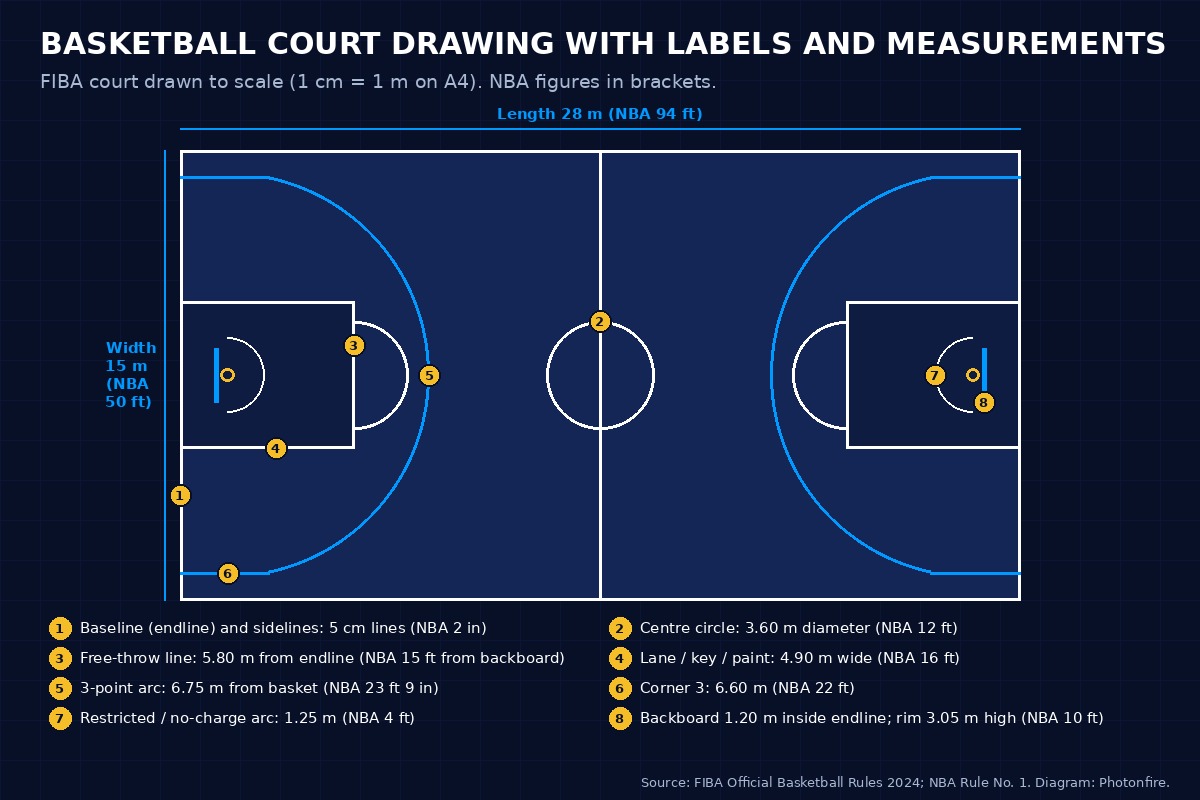
Every labelled drawing of a basketball court should name these markings. To draw and label a basketball court, start with this list:
- Baselines and sidelines: the short and long boundary lines. FIBA calls the baselines endlines.
- Free-throw lane: the rectangle under each basket, also called the key or the paint.
- Free-throw line: the line at the top of the lane where players take foul shots.
- 3-point arc: the curve, with straight corner sections, that separates two-point and three-point shots.
- Centre circle: the circle on the halfway line where the jump ball starts the game.
- Restricted area: the small arc under each basket, the no-charge zone.
- Backboard and rim: the backboard sits inside each baseline, and the rim hangs in front of it.
What Does a Basketball Court Layout Look Like?
A basketball court is a rectangle split in half by a centre line, with a centre circle in the middle for jump balls. At each end, a free-throw lane runs from the baseline towards the centre and finishes at the free-throw line and its semicircle. A three-point arc wraps around each lane, and a backboard and rim sit just inside each baseline, facing the centre of the court.
How Do You Draw a Basketball Court Step by Step?
Follow these five steps for a top-down basketball court sketch. Use a pencil, a ruler and a compass, and keep the eraser close.
- Draw the outer boundaries. Rule a large rectangle about twice as long as it is wide, leaving a margin around the edge of the paper.
- Add the centre line and circle. Rule a line across the middle, parallel to the short sides, then draw a circle on its midpoint.
- Draw the backboards and hoops. At each short end, draw a thin line just inside the baseline for the backboard and a small circle in front of it for the hoop.
- Create the paint. From the middle of each baseline, draw a rectangle reaching towards the centre. Add a semicircle on the free-throw line facing the halfway line, then a small arc round the hoop for the restricted area.
- Add the three-point line. Start on the baseline a little in from each corner, rule a short straight line towards the middle, then swing a large arc around the paint and mirror it on the other side. Check both ends match.
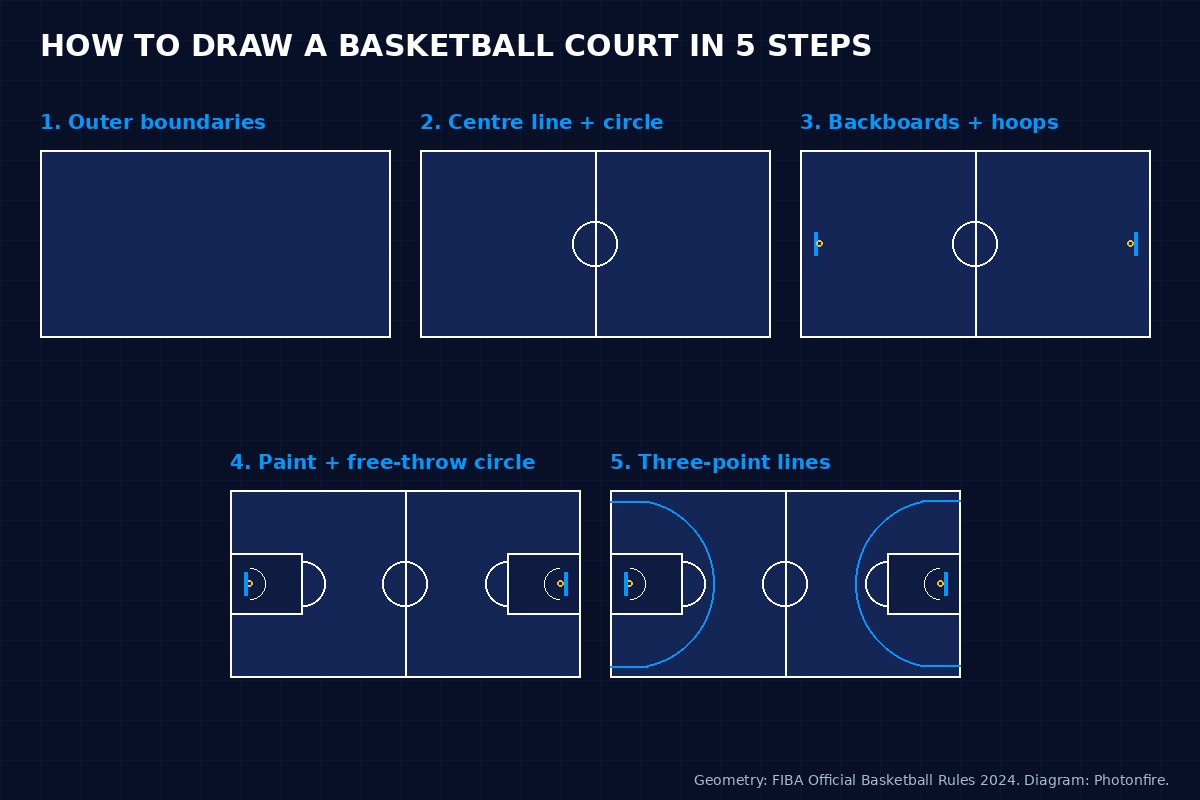
That gives you a basketball court drawing easy enough for a first attempt. To draw a basketball court and label it, add an arrow from each marking in the key markings list to its line.
How Do You Draw a Basketball Court With Measurements?
Here is how to draw a basketball court with measurements: pick a scale first, then convert every number. Two scales work well for a basketball court drawing with pencil:
- 1 cm = 1 m (FIBA): the court becomes 28 cm by 15 cm, which fits landscape A4. The lane is 4.9 cm wide, the three-point arc has a 6.75 cm radius and the centre circle a 1.8 cm radius.
- 1 inch = 10 ft (NBA): the court becomes 9.4 by 5 inches. The lane is 1.6 inches wide, the free-throw line sits 1.5 inches from the backboard and the arc has a radius of about 2.4 inches.
Set your compass point on the spot under the hoop, not on the backboard, before you draw the arc. FIBA places that spot 1.575 m from the inner edge of the endline. Write each measurement on the drawing in small print to draw a basketball court with its dimensions that someone else can check.
Can You Get a Basketball Court Drawing PDF?
Yes. Download our free basketball court drawing PDF. Page one is a basketball court drawing with label and measurements, drawn to FIBA scale with NBA figures in brackets. Page two is the full NBA vs FIBA table. Teachers can use it as a simple basketball court drawing with label for PE lessons, and the step method above also works as a basketball court drawing for kids in a classroom setting.
How Do You Draw a Basketball Court on Your Driveway?
Here is how to draw a basketball court on your driveway. Most driveways only fit part of a court, so mark a half court or just the key. An NBA half court measures 47 by 50 ft, and a FIBA half court 14 by 15 m. Measure every line from the spot on the ground directly below the centre of the hoop, then:
- Mark the lane: 16 ft wide (4.90 m) and centred on the hoop.
- Mark the free-throw line 15 ft from the backboard face, or 4.60 m under FIBA rules.
- Tie string to a peg under the hoop and swing it at 23 ft 9 in (6.75 m) for the three-point arc, cutting it short where your driveway ends.
- Use chalk for a trial run, then painter’s tape or line-marking tape once the lines look right.
What Are the Key Facts About a Basketball Court Drawing?
| Fact | Detail |
|---|---|
| NBA court | 94 ft x 50 ft (NBA Rule No. 1) |
| FIBA court | 28 m x 15 m (FIBA OBR 2024) |
| Line width | 2 in (NBA), 5 cm (FIBA) |
| Rim height | 10 ft / 3.05 m |
| Best paper scale | 1 cm = 1 m on A4 landscape |
| Drawing order | Boundaries, centre, hoops, paint, three-point lines |
Want the players behind the lines? Read our Nigeria basketball team guide on D’Tigers and D’Tigress, or the ChampSquads Nigeria basketball team profile. Wikipedia’s basketball court page also compares NBA, FIBA, WNBA and NCAA markings.
If you bet on basketball or football, read our football betting guide, check live betting and see current promotions first.
18+ only. Betting carries real financial risk. Set a budget, never chase losses and visit our responsible gambling page if betting stops being fun.
Related reading: Nigeria basketball team · foot pain causes · Super Eagles coach · correct football prediction · all guides
Sources (2026)
Court dimensions: NBA Rulebook, Rule No. 1 (2026-27 edition online), and FIBA Official Basketball Rules 2024 with Basketball Equipment 2024. Cross-checked against Wikipedia’s basketball court page. Diagrams drawn by Photonfire from these figures.
FAQ
How do you draw a basketball?
Draw a circle with a compass. Add one curved line across the middle from side to side, then a second curve from top to bottom. Finish with two arcs that bend in from the left and right edges like brackets, then shade one side for depth.
How do I paint a basketball?
Clean and dry the ball first, then mask the seams with tape if you want them to stay black. Use thin coats of flexible acrylic paint made for rubber or vinyl, let each coat dry fully and seal it. Paint changes the grip, so a painted ball suits display better than play.
Is a size 7 basketball full size?
Yes. FIBA requires a size 7 ball for all men’s competitions, with a circumference of 750 to 770 mm and a weight of 580 to 620 g. Women’s competitions use the smaller size 6 ball (715 to 730 mm), and mini-basketball uses size 5.
How to choose a basketball hoop?
Match the official specifications where you can. FIBA rings have an inside diameter of 450 to 459 mm, and NBA rings measure 18 inches inside. A regulation NBA backboard is 6 ft wide and 3.5 ft tall; FIBA’s is 1.80 m by 1.05 m. A height-adjustable system lets younger or shorter players start lower.