

A fractured bone is a break or crack in a bone, ranging from a tiny hairline crack to a complete break into several pieces.
If you ask a doctor “what is a fractured bone’ they use “fractured” and “broken” to mean exactly the same thing. In sport, that covers everything from a runner’s stress fracture to a footballer’s broken leg after a late tackle.

TL;DR
- Meaning: a fracture is a partial or complete break in a bone.
- Main split: closed (simple) fractures leave the skin intact; open (compound) fractures break through it.
- Key symptoms: sudden pain, swelling, bruising, trouble moving and sometimes visible deformity.
- Main causes: falls and tackles, repetitive strain, and bones weakened by osteoporosis.
- In sport: football’s metatarsal breaks, runners’ stress fractures and cyclists’ collarbone breaks.
Every suspected fracture needs an X-ray and a clinician’s assessment. Playing on is never the answer.
| Detail | Information |
| Medical term | Bone fracture |
| Same as a broken bone? | Yes |
| How it is confirmed | Physical exam plus X-ray; sometimes CT or MRI |
| Main treatments | Cast or splint, closed reduction, surgery |
RELATED: Causes of Muscle Pull: Why Footballers Pull Muscles and How They Recover
What Is a Fractured Bone?
A fractured bone is a break or crack in a bone, ranging from a small hairline crack to a complete break into multiple pieces. So what does a fractured bone mean medically? Exactly the same as a broken bone: a partial or complete break in the bone.
| Type | Description |
| Closed (simple) | Bone breaks but does not pierce the skin |
| Open (compound) | Bone breaks through the skin, or a deep wound exposes it |
| Hairline / stress | Small crack, often from repetitive overuse |
| Comminuted | Bone breaks into three or more pieces |
| Greenstick | Incomplete break; one side cracks while the other bends (mostly children) |
| Displaced | Broken pieces move out of alignment |
| Non-displaced | Bone cracks or breaks but stays aligned |
Common symptoms:
- Sudden pain and tenderness
- Swelling and bruising
- Difficulty moving or using the injured area
- A visible deformity or bump
Common causes:
- Sudden force: falls, car crashes, sports impacts and twisting injuries
- Repetitive strain: overuse from running or jumping, causing stress fractures
- Weakened bones: conditions such as osteoporosis or bone cancer
Key facts:
- Synonyms: broken bone, bone break, crack in a bone
- Diagnosis: X-ray is the standard test; CT or MRI may be added
- Emergency sign: bone through the skin needs urgent care
- Higher-risk groups: people with osteoporosis, contact-sport players and runners
Seek medical attention for proper diagnosis and treatment of any suspected fracture.
Information current as of November 2026. Checked against NHS, Mayo Clinic, Cleveland Clinic and Johns Hopkins Medicine guidance. General information only, not medical advice.
What Is Fracture? Simple, Compound, Displaced and Partial Breaks
Doctors describe a fracture in layers: is the skin broken, have the pieces moved, and does the break go all the way through? Those answers shape the treatment of fracture more than the bone’s name, as Cleveland Clinic explains.
What is a simple bone fracture?
A simple bone fracture is another name for a closed fracture: the bone breaks, but the skin stays intact. Most football fractures, from a cracked metatarsal to a broken wrist after a fall, are closed.
What is a compound bone fracture?
A compound bone fracture is an open fracture: the bone pokes through the skin, or a deep wound exposes it. Infection can reach the bone, so Johns Hopkins Medicine treats it as an emergency.
Paul George suffered one in August 2014, breaking both bones in his lower right leg after landing awkwardly at the base of a basket stanchion in a USA Basketball scrimmage. For current NBA injury news, see our Paolo Banchero injury update.
Displaced fractures move out of line and more often need surgery; non-displaced ones stay aligned. Partial fractures, such as hairline or greenstick breaks, do not go all the way through; complete fractures do.
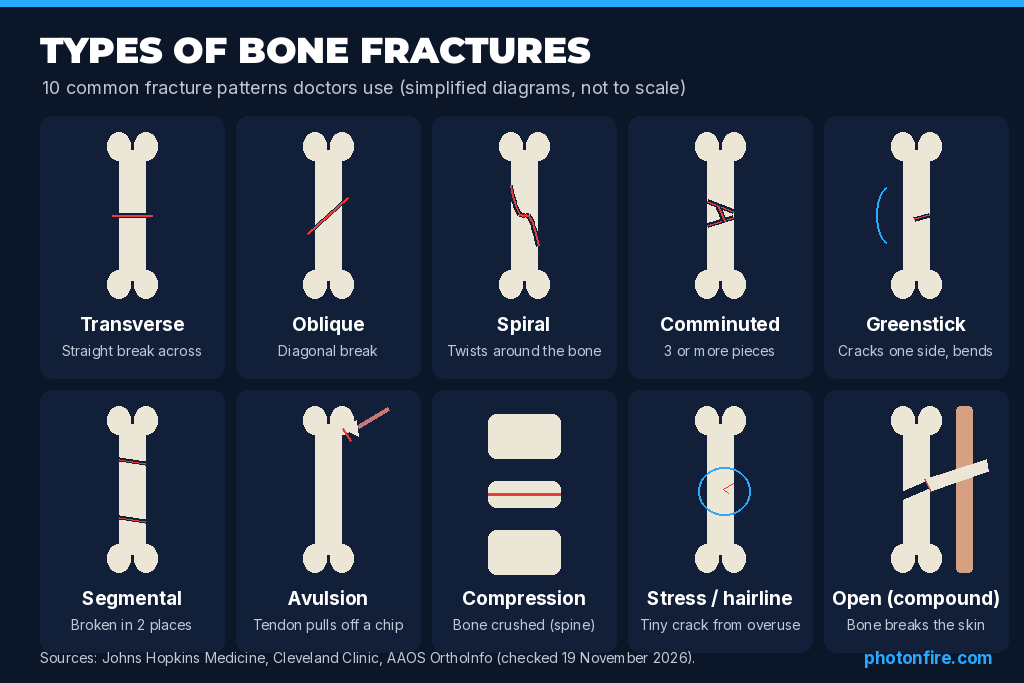
8 Types of Fractures (and the 10 Types of Fracture Doctors Use)
Johns Hopkins Medicine lists eight common bone fracture types, named mostly by the shape of the break:
- Greenstick: an incomplete break; one side cracks and the other bends.
- Transverse: a straight break across the bone.
- Spiral: the break winds around the bone, typical of twisting injuries.
- Oblique: a diagonal break.
- Compression: the bone is crushed, often in the spine.
- Comminuted: three or more pieces.
- Segmental: the same bone breaks in two places.
- Avulsion: a tendon or ligament pulls off a small piece of bone.
Add stress fractures (tiny cracks from repeated loading) and buckle fractures (a child’s bone squeezed by a fall) and you have the 10 types of fracture found on most medical lists.
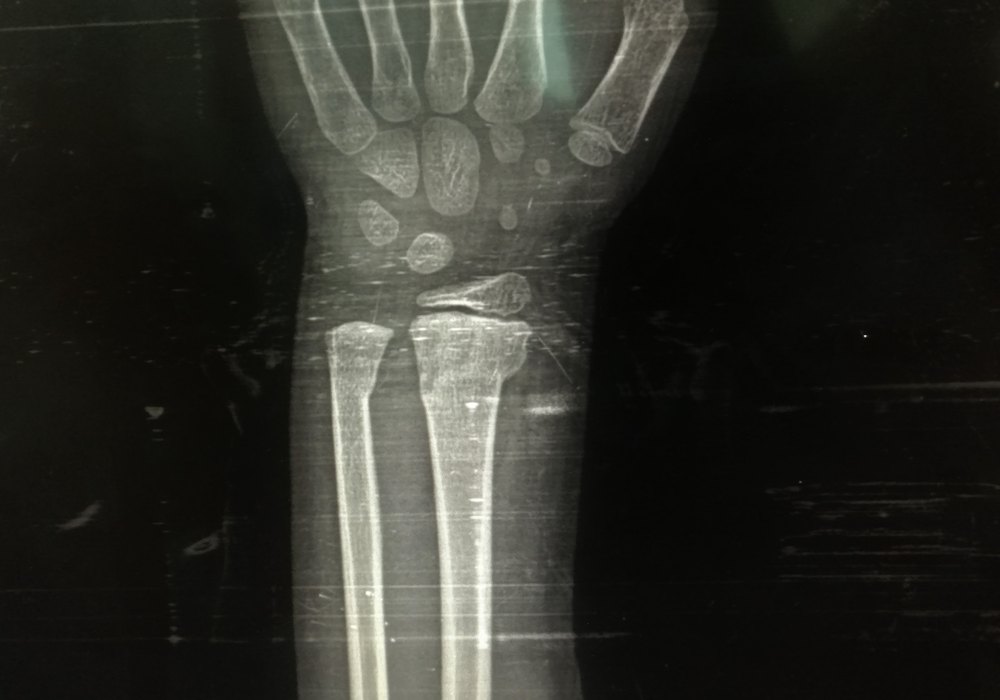
What is a greenstick bone fracture?
A greenstick bone fracture is an incomplete break in which the bone cracks on one side and bends on the other, like a green twig. It happens mainly in children, whose bones are softer and more flexible. A youngster falling on an outstretched arm in a school match is the classic case.
What is a comminuted bone fracture?
A comminuted bone fracture is one where the bone shatters into three or more fragments. It usually takes high energy, such as a car crash or heavy collision, and often needs surgery.
SEE ALSO: Foot Pain Causes: Types, Symptoms and the Footballers Who Lived With Them
Bone Fracture Types in Sport: Footballers, Runners, Boxers and Cyclists
Sport produces almost every type of fracture. These well-documented cases show what they look like.
Broken legs and metatarsals in football
Wayne Rooney broke his fourth metatarsal after a challenge from Paulo Ferreira at Chelsea in April 2006, weeks before the World Cup. Neymar broke his fifth metatarsal against Marseille in February 2018 and missed Paris Saint-Germain’s Champions League second leg against Real Madrid; see our Neymar profile.
Leg breaks from tackles are rarer but more serious. Aaron Ramsey broke his tibia and fibula at Stoke in February 2010, and in 2008 Arsenal’s Eduardo suffered a broken left fibula and an open ankle dislocation at Birmingham. Follow current cases in our Arsenal injury news and Man Utd injury news.
Stress fractures in runners and athletes
Stress fractures are most common in the lower leg and foot. Mayo Clinic lists track and field, cross-country, basketball, tennis, dance and gymnastics as higher-risk sports, especially when training increases too fast. Raúl Asencio’s leg stress fracture features in our Real Madrid injury list.
Boxer’s fractures and collarbone breaks
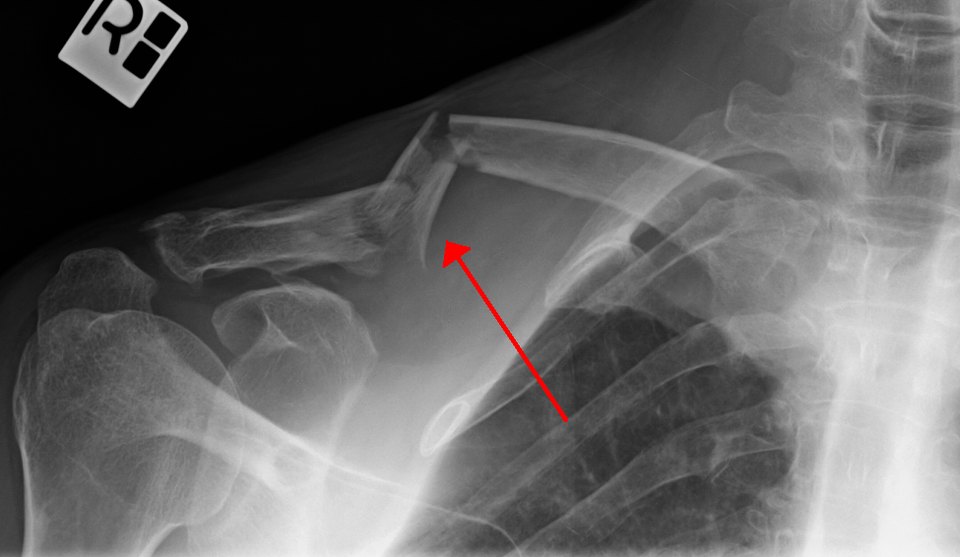
A boxer’s fracture is a break in the fifth metacarpal, the hand bone below the little finger, usually from punching something hard. Collarbone breaks are common in cycling and rugby falls: Bradley Wiggins crashed out of the 2011 Tour de France with one.
Goalkeeper Emiliano Martínez was named in Argentina’s squad despite a broken jaw, as our Argentina match preview reported. Club absences are tracked on our football injury updates page and in ChampSquads injury updates.
READ MORE: Moisés Caicedo: Injury, Contract, Stats & Chelsea News
Causes of Fracture: Force, Overuse and Weak Bones
A bone breaks when hit by more force than it can absorb. Bones are weakest when twisted, so a planted boot and turning body can cause a spiral fracture. The main causes of fracture:
- Trauma: falls, car crashes, direct blows and tackles.
- Overuse: repetitive running or jumping tires the muscles and passes load to the bone. Johns Hopkins notes stress fractures are more common in athletes and military recruits.
- Weakened bones: osteoporosis or bone cancer can let a bone break after a minor fall, known as a pathological fracture.
Contact sports raise fracture risk, as does ramping up training too quickly. Compare muscle injuries in our muscle pull guide, or see basketball patterns on our Jalen Duren injury page.
Bone Fracture Symptoms: How to Spot a Break
Bone fracture symptoms usually appear straight after an impact. Watch for:
- Sudden, sharp pain, worse when pressed or moved
- Swelling, bruising, warmth or redness
- Being unable to use the limb or put weight on it
- A limb that looks shorter, twisted or bent
- A grating feeling as broken ends rub together
Stress fractures differ: pain starts mild, worsens with activity and eases with rest. Mayo Clinic says pain at rest or at night needs prompt checking.
The NHS says call 999 or go to A&E if a limb is twisted or bent, bone is sticking out, or skin turns cold, sweaty or pale. Pitchside, keep the limb still, pad it and do not let the player continue.
Treatment of Fracture: How Bone Fracture Treatment Works
Bone fracture treatment aims to line the pieces up, hold them still, control pain and restore use. After an examination and X-ray (sometimes CT or MRI), the options are:
- Immobilisation: a cast, splint or brace for non-displaced breaks.
- Closed reduction: resetting a displaced bone from outside, without surgery.
- Internal fixation: surgery with plates, screws or rods.
- External fixation: pins attached to a frame outside the body, used when skin and soft tissue are badly damaged.
- Traction: steady pulling to align the bone, usually temporary.
The surgeon decides when a player can return to contact training, as seen in Bayern Munich injury news, Manchester City injury news and Chelsea injury news.
What Is the Cause of Itching on a Fractured Bone?
Itching around a healing fracture is common and usually a sign that repair is under way. The main causes are:
- Inflammation: the healing response releases chemicals such as histamine, which stimulate itch-sensing nerves.
- Nerve regrowth: research shows nerve fibres sprout into the fracture site as new bone forms.
- Skin repair: skin stretched by swelling itches as it heals.
- The cast itself: trapped sweat, damp padding and dead skin cells irritate the skin.
Never push a ruler or coat hanger down a cast to scratch, and do not use powders inside it. Contact the fracture clinic if itching persists, the cast smells or feels wet, or the skin turns red or raw.
Sources (2026)
- Cleveland Clinic, Bone Fractures, reviewed 15 January 2026; Boxer’s Fracture, 16 October 2023.
- Johns Hopkins Medicine, Fractures: eight fracture types, causes and treatment.
- AAOS OrthoInfo, Fractures (Broken Bones) and Care of Casts and Splints.
- NHS, Broken leg and Broken collarbone.
- Mayo Clinic, Stress fractures, 25 April 2025.
- Current Osteoporosis Reports (2023): nerve sprouting in fracture repair.
- Wikipedia athlete profiles citing BBC Sport, checked 19 November 2026.
FAQ
How long does it take for a fractured bone to heal?
It depends on the bone, the break and your age. The American Academy of Orthopaedic Surgeons says finger fractures can heal in three to four weeks, others six to eight weeks or longer. The NHS says a broken leg usually takes 6 to 12 weeks. Severe fractures can take a year or more.
What is the hardest broken bone to heal?
The scaphoid, a small wrist bone at the base of the thumb, is one of the hardest. Parts of it have a poor blood supply that runs “backwards”, so a break can cut off blood flow. Healing problems, including bone death (avascular necrosis), are more common than in other bones.
What vitamins help heal bones?
Vitamin D and calcium are the key nutrients for bone strength; vitamin D helps your body absorb calcium. The NHS also recommends enough protein. Get them from dairy, oily fish, eggs and fortified cereals, and ask a doctor before taking supplements, particularly if you have osteoporosis.
What drink is good for bone repair?
Milk and calcium-fortified plant drinks, such as soya or oat milk, supply calcium, and many are fortified with vitamin D. Limit alcohol: orthopaedic surgeons warn that alcohol and smoking weaken bones, and Johns Hopkins Medicine says tobacco interferes with healing.